Continental Flag Matching Challenge
Reviews
Continental Flag Matching Challenge does one thing well: it drills flag-to-country associations through repetition and instant feedback. The absence of timers or scores keeps the focus on learning rather than performance, which suits children and casual learners. The regional coverage from Canada to the Caribbean offers breadth without overwhelming. The main limitation is that it is purely a matching exercise; players seeking deeper geographic context will need to supplement it with maps or other study materials.
Description
How the Matching Works
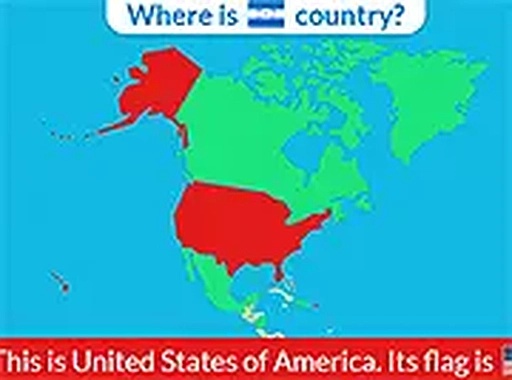
Each round shows a single flag alongside a short list of country names. The player selects the country they believe matches the flag. If the choice is wrong, the game immediately displays the correct answer, creating a direct association between the visual symbol and the country. This correction loop is the core learning mechanic, and it repeats across many flags so that details like stripe order, emblem placement, and color combinations become familiar over time.
Regional Scope and Progression
The flag set covers a wide geographic range, from Canada down through Central America and into the Caribbean. That spread includes both widely recognized national flags and less common territorial or regional emblems. Because the game does not lock players into a fixed sequence, they can work through one subregion at a time or mix flags from different areas. This flexibility supports gradual expansion of knowledge without overwhelming the player with too many new symbols in a single session.
Controls and Accessibility
The interface is deliberately minimal. Players interact only by tapping or clicking a country name, and the game runs entirely in a web browser on phones, tablets, and computers. No installation is required. A full-screen option removes surrounding browser elements for a cleaner view. There are no timers, score penalties, or forced pacing, so players can consider each flag for as long as they need and repeat rounds freely.
Practical Study Approaches
Pairing the game with a map of North America can help players connect each flag to its geographic location, turning isolated symbols into spatial knowledge. Focusing on one subregion per session, such as Central America or the Caribbean islands, tends to make the material more manageable than attempting the full set at once. Short, regular practice sessions are generally more effective for retention than occasional long ones.







Editorial Notes