Crate Logic: Puzzle Platformer
Reviews
Crate Logic succeeds by narrowing its scope. One crate, four actions, and a series of self-contained rooms create a puzzle game that rewards observation over reflexes. The lack of timers and the presence of multiple solutions in some levels give it a relaxed, experimental feel. It is best suited to players who enjoy quiet problem-solving, and its simple controls and non-violent content make it a reasonable choice for younger players or shared family sessions.
Description
The Crate as a Tool
Crate Logic hands players one interactive object and asks them to solve every problem with it. A crate can be pushed into a gap to create a bridge, stacked to form a staircase, or thrown to hit a switch from a distance. Each action changes how the room can be traversed. Early stages introduce a single crate and a clear goal, while later rooms combine multiple crates, moving platforms, and timed elements. The challenge comes from reading the environment and deciding which use of a crate fits the situation.
Room-Based Level Design
Every stage is a self-contained room with a defined entry point and an exit. The route between them is deliberately hidden behind pits, walls, and raised platforms. Some solutions require exact positioning, while others depend on performing actions in a specific order. The difficulty curve stays gentle at first, letting players learn the crate's behavior before facing more intricate layouts. Because there are no timers or score multipliers, players can experiment freely and retry without pressure.
Readable Visuals and Immediate Feedback
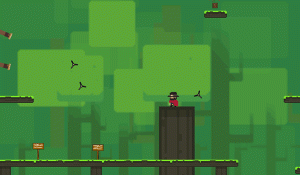
The art style uses clean lines and distinct colors so every element is easy to identify. Crates have a textured wood appearance, and the character stands out clearly against the background. When a crate is pushed, it slides with a satisfying sound and stops exactly where the player leaves it. That immediate response helps players understand cause and effect without guesswork. The interface stays minimal, with no distracting menus or pop-ups during play.
Progression and Replay Potential
Levels unlock in a linear sequence, so each completed room opens the next. The absence of time pressure encourages players to test different approaches after a failed attempt. Some levels accept more than one valid solution, which gives tinkerers a reason to return and optimize their route. Controls are limited to moving, pushing, jumping, and throwing, making the game approachable for young children and adults alike. There is no text-heavy tutorial; the opening levels teach through play. The content contains no violence, mature themes, or online interactions, so it works for solo sessions or shared family play.
Compatibility
Faq
What is the main goal in Crate Logic?
Does Crate Logic have a time limit or score system?
Is Crate Logic suitable for young children?
How does the difficulty progress in Crate Logic?
Can I play Crate Logic with another person?
What makes Crate Logic different from other puzzle platformers?
Related Titles

Amazon Enigma Temple Adventure

Galactic Pixel Storm Space Shooter

Hold Position 3 Defense Strategy
World Explore Idle Strategy
Frontier Space Precision Pilot

Waffle Word Puzzle Challenge

Word Salad Puzzle: Word Game
Word Snatch Puzzle Game

Word Twist Puzzle Game
Word Search Puzzle Online
Daily Word Puzzle Challenge
Editorial Notes